Hi again,
Thanks for joining us this week, I know I said that posts may be a little more sporadic but over a few days off recently I was hit with inspiration to write a post, so here we are!
This week we have the last instalment of the ingredients series. So far we have looked at Malt, Hops, Yeast, Water and last week’s post on Specialty Ingredients, what could possibly be left? There is one ingredient that doesn’t really fit into any of these categories, and that is Fining agents you can add to help clarify your beer. Read on below to hopefully gain a little more clarity (pun intended) on these ingredients, the way they work, are made, and some other methods you can use instead of or alongside finings to help clear your beer.
Last Week In New Beerginnings
This week I have bottled the Cascade/Centennial Pale Ale I made as well as trying the first one after only 4 days in the bottle because I couldn’t wait! The result was delicious but predictably under carbonated. I’m now going to exercise a little more patience and wait a couple of weeks.
This week coming I am planning to brew a strawberry blonde ale to make use of the cheap strawberries around at the moment in Queensland. Look out for a brew day post soon after!
Now into this week’s topic.
What are Finings?
Lovers of a good hazy NEIPA read no further, for the following statement could shock you.
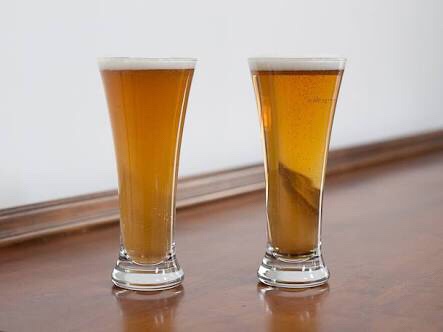
The majority of brewers love to see a nice clear beer in their glass.
Sure, hazy or juicy beers have their place but there is something very satisfying about producing a crystal clear lager or IPA. In the culinary world it’s a common saying that you eat with your eyes first and certainly for me this translates to the world of beer. I think part of it is the surprise. You’re almost expecting a certain flavour or juicy character from a hazy or opaque beer because you can see…stuff in it. With a crystal clear and bright beer it seems like “how can there be any flavour in here? It looks like yellow water!” Then getting hit in the face with a flavour bomb of great crackers malt character in a Pilsner or intense hop character from an IPA.
Brewers have searched high and low for the best ways to clear their beer over the years and have found several methods over the years. I’ll go through the specifics later but first I’ll look at how finings work as a concept.
Opposites Attract
Most particles carry some sort of positive or negative charge. Only very few elements are naturally neutral. Any chemical reaction is basically an exchange or sharing of electrons to allow both particles involved in the reaction to reach a more stable state than they had on their own.
But how does this relate to beer?
Like everything else, beer contains particles, both positively and negatively charged. The way finings work is taking advantage of these charges to drop certain particles out of solution, making the beer clear.
To be slightly more specific, the particles in beer that cause haziness, like yeast and hop particles stay in suspension because they are small enough to float and stay in the beer indefinitely. Overall they have a positive charge, so finings (negatively charged) work to bind themselves to these particles and therefore make them larger and heavier, making them easier to drop out of suspension.
So to answer the question in the heading of this section, Finings are an ingredient you add to your beer that helps drop out particles that would otherwise make it hazy.
I will also add a little note about other methods of clearing your beer that can be used in lieu of, or alongside your finings.
Types of Finings
Auxiliary Finings Vs Finings
So when I say haze-causing particles in beer are generally positively charged, there are in fact some negatively charged ones too. They are typically produced on the hot side of the beer making process and are a large component of kettle trub. Auxiliary or kettle finings deal with these quite effectively by being positively charged and binding themselves to the negatively charged particles.
You would never add Auxiliary and normal Finings at the same time as they would only serve to attract each other, negating the effect they would otherwise have on your beer. Auxiliary Finings are also sometimes called Kettle Finings as that is the place you typically add them to aid the settling out of kettle trub so it doesn’t make its way into the fermenter.
The first fining I will talk about is Irish Moss, the common term for Carrageenan, is a Kettle fining that is added towards the end of the boil, usually at 10-15 minutes to go. Originally derived from a particular species of seaweed, it is very effective at helping to drop out kettle trub. Care must be taken to not add too much or too little as too little and it will not be very effective but too much may also cause issues down the line when using other finings later in the process. A permanently hazy beer could result. They typically come in packs with instructions on how much to add for the amount of beer you have, I’d follow these instructions to the letter as the other potential downside is having your beer taste like seaweed!
Whirlfloc is a commercially produced, tablet version of Irish moss and should be available at most good Home Brew Stores. Typically designed for a 40L/10Gallon batch, I’d recommend using half a tablet, crushed/cut up and sprinkled into the wort at 10 minutes to the end of the boil.
Gelatine is a very common fining in the home brewing world, it used to be in the commercial brewing world also but is falling away somewhat due to the fact that it is derived from animals and breweries tend not to want to eliminate potential vegetarian or vegan customers. Gelatine is a substance that helps to coagulate molecules and is the component of Jelly that makes it come together and wobble in the oh-so-satisfying way that it does. It is made by boiling any animal parts like skin, bones, cartilage, horns for a very long time until the connective tissues all start to break down and the Gelatin separates. It is then either sifted, filtered or evaporated away from the rest of the matter.
Yep, gross… Does it stop me from using it in beer? No, unless I am making a beer that I know could potentially be drank by a vegetarian or vegan.
Gelatine is typically added at the end of primary fermentation and works very quickly, 24-48 hours is typically all it needs in my experience. It’s prepared by preparing a bowl of hot water (microwaved for a minute or so), dissolving the gelatine into it and then dumping that into the beer.
It’s also sometimes referred to as powdered time, in the sense that it seems to promote several aspects of beer that typically only come with time. Clarity, for one, but also other aspects like the depletion of hop flavour and aroma. It can be also used to partially or completely skip the “green” phase of beer that usually stays around for a couple of weeks after it is kegged/bottled that can make it not as pleasant to drink.
The difference Gelatine makes is incredible, but it even more effective is our next fining.
You may have heard of this one, it is an ingredient that is quite polarising but has been common in some very popular beers in the past, most notably Guinness until recently. It works in much the same way as Gelatine but is reportedly much more effective. It is made by dissolving in acid and purifying the swim bladders of fish. It is odourless, colourless and almost pure collagen. It has such a strong effect that it is actually able to work repeatedly, meaning if you move the beer and take some particles from the bottom and put them back into suspension it will reclarify the beer. This is something that sets it apart from other finings like gelatine, which can only clear the beer one time and repeated shaking or moving of the vessel will put the particles back in suspension.
It is used in the same way as gelatine but as it comes in sterile liquid form, only needs to be tipped in, no further preparation required.
Finally something for the vegans! Not all finings come from unspeakable parts of animals boiled for hours until they are left in a gelatinous goop.
Biofine clear is a colloidal solution of silicic acid in water designed to aid the sedimentation of yeast and other particles from beer.
A colloidal solution is basically a solution in which microscopic particles of an insoluble substance is distributed and suspended within another. Much the same as yeast suspended in beer, the yeast does not dissolve into the wort/beer but it does stay evenly distributed in suspension throughout the beer.
Again, this is designed to be added to the fermenter but the difference here is that it’s essential to make sure it is evenly distributed in the beer. The easiest way to do this would be transfer the beer from the primary fermenter to a separate fermenter for secondary fermentation or ageing and put the finings in the secondary fermenter in the same way you would do for sugar in a bottling bucket for bulk priming.
Polyclar is a fining that is a specially formulated plastic designed for use in wine and beer brewing, yes, it’s a plastic! Again, even distribution is a must for this one so I’d recommend the same racking to a secondary fermenter method.
After use, Polyclar must be filtered out for safe consumption, so I would also invest in a beer filter. An in-line filter like this one should suffice.
Filtering
The other way to clarify your beer without using any other fining agents or ingredients is to filter it. This involves either a small gravity-fed filter like the one above, which is great for larger particles like hop material but some microscopic particles could still slip through. The other option is a filter that has a 1 micron or smaller cartridge and can handle a pressurised transfer from a pump or gas line, here is an example and the filters to go with it.
I myself have not filtered any beers, nor do I have plans to. I’m happy with the clarity I am able to achieve with careful brewing practices, ingredient selection and use of finings when necessary. I rarely even use gelatine, my process is typically
– 1/2 a whirlfloc tablet at 10 minutes to the end of the boil,
– A whirlpool at the end of the boil to concentrate the kettle trub and hop matter in the middle of the kettle, rack off to my counter flow chiller from the side of the kettle to avoid the trub.
– Cold crash at the end of fermentation.
If I feel that either due to the ingredients or the style of beer, extra steps are required, I have used gelatine in the past to get that extra bit of clarity.
Cold Crashing
Cold crashing is a technique you can use on its own or in conjunction with the other ingredients/methods.
It works on the basic premise that we learned in high school science class. You can dissolve more sugar in 1L of hot water than 1L of cold. Cold crashing brings the temperature of the beer right down to just above freezing point (usually 1-2°C or lower) and holds it there for 1-3 days in order to reduce the amount of particulate it’s capable of holding. Any particulate that it can no longer hold simply drops out and usually remains at the bottom of the fermenter unless it is stirred back up.
Especially when used in combination with finings it produces a very bright and clear beer. If you are only crashing with a normal fridge without a temperature controller then it will only get between 4-6°C so I would advise leaving it for a little longer, perhaps 4-6 days.
Conclusion
Thanks for joining us in the last of the ingredients series. I hope you are now even more confident in using finings and know a little more about the background of them and how they work.
Posts will continue here frequently and will focus on various aspects of producing beer. Everything from spotlights on certain aspects of the process or equipment to recipe creation and even tasting.
Until next time,
All the best,
Sean
If you have any feedback or edit suggestions for this post please contact us and let us know. We want to ensure the correct information is presented in the best possible way so that fellow brewers can stay well-informed.
Want to stay up to date with the latest from Sean and New Beerginnings? Like us on Facebook and Instagram or reach out to us on Reddit.
If you are in any way interested in contributing to the blog I’m all ears, message me on here using the contact form on the site or reach out on social media.
 New Beer-ginnings