Hi all,
Thanks for joining us this week in the second instalment in our ingredients series where we discuss everyone’s favourite plant, Hops! Sorry for being a day late on it, I intended to get it out over the weekend here but had a migraine on Sunday so could barely think let alone write a post on such a large topic!
Since this is potentially a MASSIVE topic, we’re going to go through as much detail as possible to get you brewing and using this ingredient with confidence. We will try not to delve too deep into the science aspects, that comes in a later, significantly larger post!
Last Week In New Beerginnings
This past week I have only had chance to deal with the beer that I currently have in the fermenter, the Pilsner I brewed in a recent post. I moved the temp up and down a little for Diacetyl rests and a cold crash. I’m happy with how it’s turned out other than a little chill haze that bugs me but I’ll work out when I rebrew it. It smells and tastes fantastic, even with no carbonation!
I bottled that brew and now just have to sit and wait for a few weeks for it to carb up. Meanwhile I can think about what beer I’ll brew next.
For now though, lets focus on the present, that means moving on to our main segment this week, Hops.
Hops
Hops are the flower of, most commonly, Humulus Lupulus, a climbing, perennial plant that contain compounds to add bitterness along with flavour, aroma and antiseptic properties to beer. They are used by brewers the world over and are by far the most popular bittering ingredient in beer. In the family Cannabinaceae, they are relatives of cannabis. Don’t let this fool you into thinking you can smoke them or use cannabis in beer in place of hops! They are in the same family and retain some of the same properties in regards to potential for anti-bacterial and medicinal use but that’s where the similarities end!
Initially used for these antiseptic properties, the introduction of hops would allow beer to stay unspoiled for longer periods. Their bittering properties were initially a downside and were just ‘put up with’ since this was far outweighed by the benefits of using them as an antiseptic and stabilising agent.
Before hops, people used other plants or combinations of plants such as mugwort or Gruit in beer to add similar properties. The use of hops in beer was first noted as far back as the 9th century and became popular initially in the Hallertau region of Germany. This region still produces the most hops out of anywhere else in the world. Other popular areas include Europe and the U.K, the U.S, Australia and New Zealand.
Each of these regions has a different species within the Humulus genus, Lupulus are European hops, Lupuloides, Neomexicanus and Pubescens are native to North America for example. This means each region tends to have some similar characteristics and mixing different regions requires good knowledge of the hop’s properties.
Anatomy and Types of Hops
Hops are the flower of the plant and the structures within this flower contain all the compounds that brewers seek to extract and use to flavour their beer. Below you will see a diagram and cross section of a hop flower pointing out several anatomical structures.
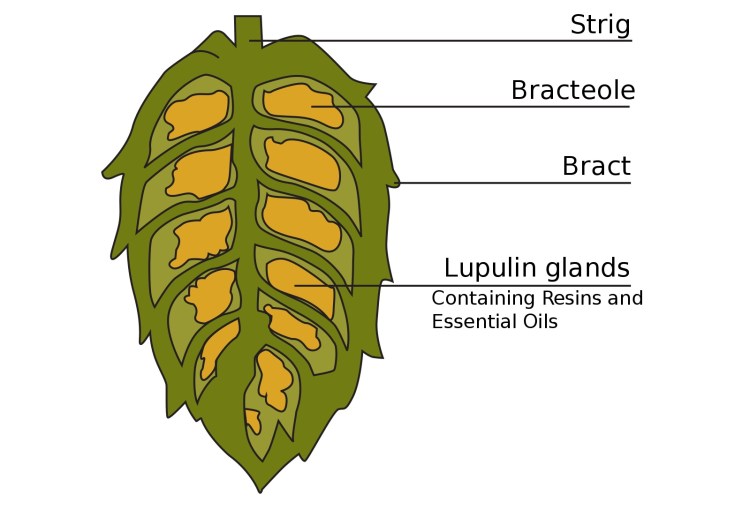 Obtained from http://bioweb.uwlax.edu/bio203/s2009/sewalish_andr/Humulus%20Lupulus%20-%20Common%20Hops/Hop%20Anatomy%20and%20Chemistry%20101.html
As you can see, one of the most important parts of the hop plant is the Lupulin gland. They are the yellow glands of hop plants containing essential oils and acids that make your beer bitter. There are two kinds of these acids:
- Alpha Acids – These are the main component that provides bitterness. Highly insoluble in their natural form, they get changed (through a process called Isomerisation) into a different form when exposed to heat and convert to Iso-Alpha Acids. These Iso-Alpha Acids are soluble and impart bitterness to the beer, They are broken down even further into the 5 following compounds. Humulone, Adhumulone, Cohumulone, Prehumulone and Posthumulone. Of these, the last two are present in such low levels that they are mostly considered negligible and Cohumulone in high levels gives a very harsh bitterness.
- Beta Acids – There are 4 of these, Lupulone, Colupulone, Adlupulone and Prelupulone. They are similar to Alpha acids in that they impart bitterness but do not do so through isomerisation during the boil. They remain insoluble and convert to a soluble state with age or oxidisation. They are generally considered undesirable.
- The other thing that is produced by the Lupulin gland is essential oils that contribute flavour, aroma and even foam stability to the beer. There are too many to list and go through individually but they give an incredibly wide range of flavours, some nice and some not so much. See below, they can be,
- – Fruity – Citrus, Pineapple, Passionfruit, Blackcurrant
– Floral – Geranium, Rose, Mint
– Spicy – Black Pepper, Aniseed
– Vegetative – Grassy, Capsicum, Cucumber, Potato
– Nutty – Almonds
– Caramelised – Honey
– Woody – Balsamic, Vanilla
– Earthy – Mushroom
– Chemical – Cabbage, Rancid (cheese or sweat), Catty (also referred to as cat piss)
– Microbiological – Cheesy, Fatty
Production of Hops
Hops are grown for commercial use in Hop fields that are geared specifically towards growing them. Even though Hop plants are incredibly resilient plants and capable of high rates of growth (even up to 1-2 feet a week!), commercial Hop growing facilities like Hop Products Australia take great care to ensure ideal conditions for their hops to grow efficiently and healthily.
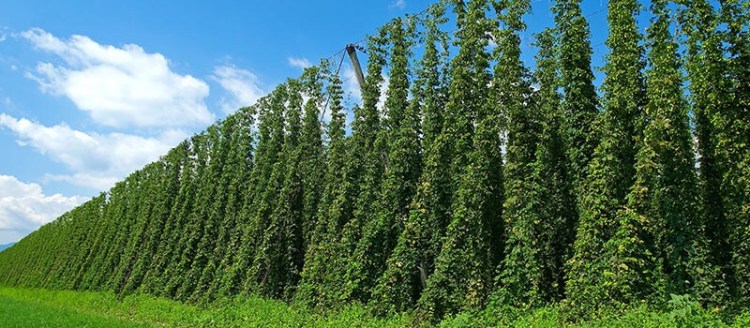 Hop Field in WI, USA, © 2018 Gorst Valley Hops
Since they are naturally a climbing plant, most often Hop fields have a lattice system of wires for the plants to attach to and grow vertically. This also makes them easier to harvest as they are hung vertically. After they are harvested, they are moved into an Oast House for drying and packaging.
Hops are available in several different forms to brewers, each has it’s own advantages and disadvantages:
- Wet Hops – Rarely found commercially due to an extremely short shelf life. Wet Hops are what comes straight off the vine, before the drying process. Because they have not been processed or dried, the amount of acids and essential oils is significantly lower per weight of product than other forms of Hops. Using Wet Hops usually requires using more than you would with other kinds. They can also only be purchased at or shortly after harvest time.
- Whole Cone Hops – These are Hops that have been dried but have had no more processing than that. They have a slightly longer shelf life than Wet Hops but must still be used quickly to avoid spoiling. Like Wet Hops, Whole Cone Hops must be used in larger quantities than many other forms as the contents of important structures like the Lupulin Gland are not as concentrated for the same weight of hops.
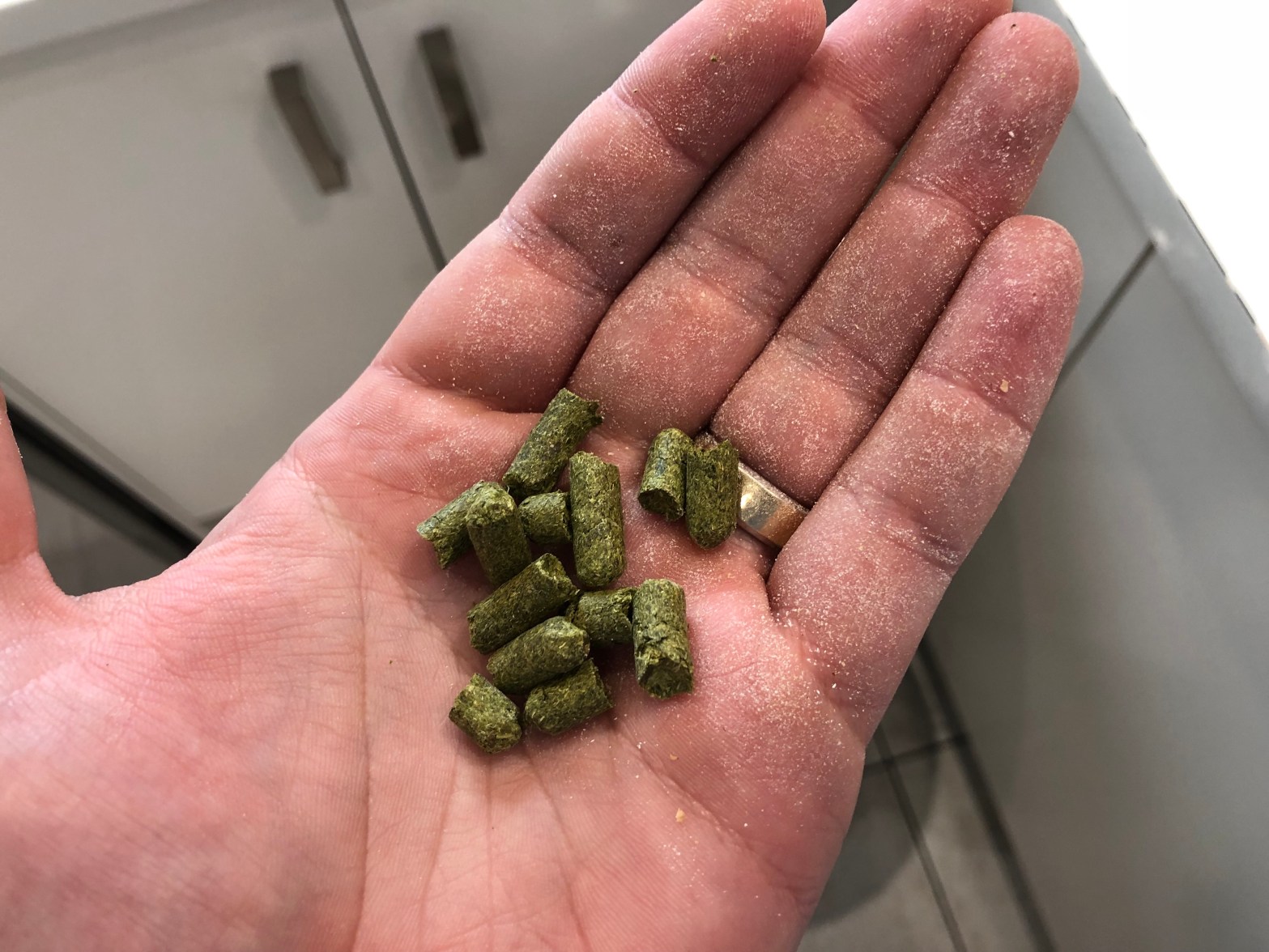
- Hop Pellets – Probably the most popular form of Hops available to brewers. Hop Pellets are the product of Hop cones that have been dried, unnecessary material removed, macerated into very fine material and fed through a machine that compresses the material into pellets. This leads to high levels of Alpha Acids and Essential Oils per pellet as well as a reasonably long shelf life when stored correctly.
- Hop Hash – This resinous mash of Hop matter is highly concentrated, with Alpha Acid and Essential Oil levels often 2 or 3 times higher than would otherwise be found in the same hop. When a hop is pelletised, some hop matter is left over in the machine, it is highly compressed or mashed and so contains far more oils and acids than normal. These must be used in lower proportions than whole or pelletised Hops but can also be used very effectively as a dry hop due to the high concentration of aromatic essential oils.
- Hop Extract – There are 2 main kinds of Hop Extract, CO2 and Iso Extract. CO2 Extract is designed to be used during the boil in place of using hop pellets. It should work the same as regular hops, with early additions being isomerised and used for bittering and later additions used for flavour/aroma. Iso Extract is pre-isomerised extract that is typically effective only for adding bitterness after fermentation. Be aware that they will add bitterness very successfully but also add haze to the finished beer.
Hop uses
There are many ways to use hops, different stages to add them to the wort/beer that achieve different effects, different combinations of hops to adjust the flavour and aroma of your beer etc. Firstly however, I’d like to talk about these different effects that hops can have in beer and how they can be achieved practically. Then I will move on to different ways and combinations of adding them to beer to achieve those effects.
Any addition of any hop to your wort/beer will achieve one or more of the following.
– Bitterness
– Flavour
– Aroma
Which of these you will get from that particular addition is denoted by the amount of time the hops are in contact with boiling wort. Due to the process of Isomerisation, where heat over time causes the insoluble Alpha Acids to turn into soluble Iso-Alpha Acids, the longer hops are in contact with vigorously boiling wort the more bitterness they will impart. During this time the hops will also release essential oils into solution that will affect flavour and aroma. These are broken down and boiled away in time so these additions must generally be done later in the boil. See below for another beautifully hand-drawn diagram of hop utilisation over time.
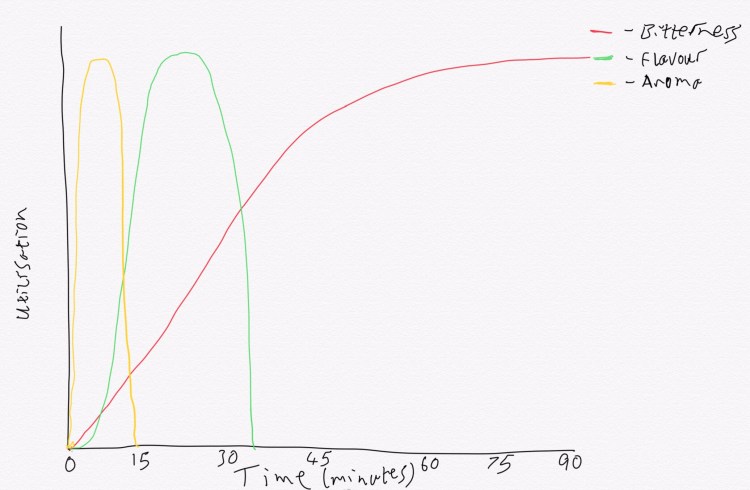
As you can see, although this is definitely not to scale, it gives you the general idea that bitterness increases with time until all the Alpha Acids are Isomerised whereas flavour and aroma build and drop very quickly as the essential oils are absorbed then boiled off.
To get a predictable result, brewers often use specific times for their hop additions to achieve the desired aspect. See below for typical hop addition times (in minutes)
60 Minutes or more – Alpha Acid conversion to add lots of bitterness, little to no flavour, little to no aroma.
45 Minutes – High bitterness, medium flavour, little to no aroma.
30 Minutes – Medium bitterness, high flavour, low aroma.
15 Minutes – Little bitterness, medium flavour, high aroma.
0 Minutes (Flame Out) – Little to no bitterness, very low flavour, very high aroma.
However, hops are not exclusively added during boiling. There are many times that brewers can choose to add them, each contributes a different character.
Boil – Most common method of hop addition, this achieves everything from bitterness through to flavour and aroma.
Dry Hop – This occurs in the fermenter after or sometimes during active fermentation. This contributes strong aroma but can contribute haze to the beer, especially if used during active fermentation. This is undesirable for most beers but a vital aspect of some more modern styles such as NEIPA which is characteristically hazy.
Whirlpool – Occurring at the end of the boil, the whirlpool phase helps concentrate the Hop matter and hot break material to the centre of the boil kettle. Some brewers use this time to add extra hops in place of a late boil addition to achieve some extra aroma.
First Wort Hop – This is when hops are added during the beginning of the sparge when the ‘first wort’ is collected in the kettle. It contributes almost exclusively bitterness but some anecdotal evidence suggests it can lead to a smoother and more pleasant bitterness than early boil additions.
Mash Hop – Similar to First Wort Hop but occurring during the mashing stage instead of adding hops to the first runnings of the sparge. You add your hops to the mash along with the grains. It achieves a similar character to First Wort Hopping.
The other thing that must be talked about in terms of the practical use of hops is choosing which hop to use. Some styles necessitate a particular hop, such as Saaz in a Czech Pilsner, but for the most part hops are best picked according to the brewer’s individual tastes and preference for where they want that beer’s direction to go. I’ve found the Hop Flavour Spectrum, by Hop Products Australia, to be incredibly useful in characterising hops. I have plotted this chart with my own favourite hops too so I can choose which hops would blend together nicely.
See the chart below, all copyright for this chart goes to Hop Products Australia, I am recommending its use purely as a home brewer and do not claim to have any official partnership with Hop Products Australia, other than buying their hops for my own use.
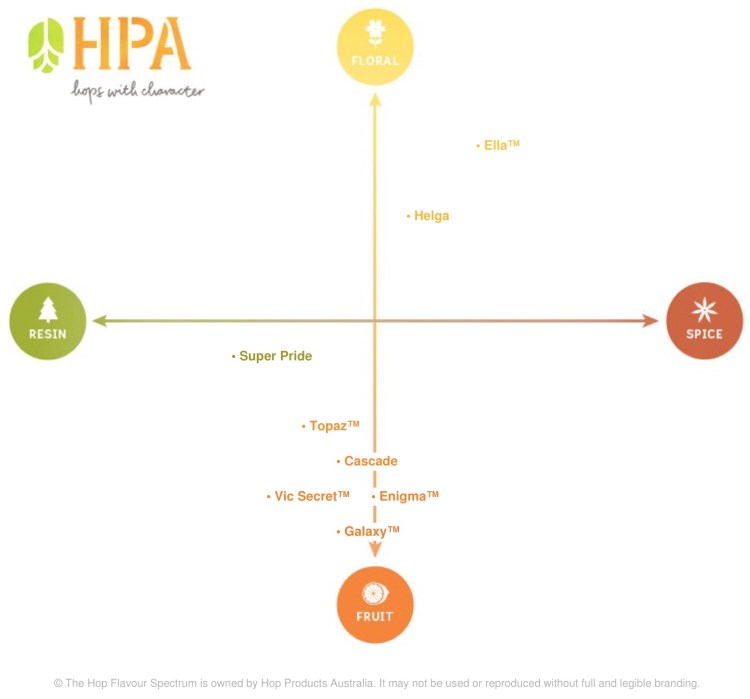
Successful hop pairings would include hops from similar groupings or combine with a neutral hop that isn’t going to battle against the others. For example from the chart above, it would make for a very unusual pairing to use Vic Secret and Ella Hops whereas Galaxy and Enigma would pair together brilliantly and compliment each other’s flavour.
Here are some common pairings and an example of what character they would give the beer:
Citra and Centennial – A Bright citrus flavour and aroma with high bitterness, perfect for fruity American IPAs.
Fuggles and East Kent Goldings – Earthy, floral, classic British flavours.
Tettnanger and Hallertau – Floral and Spicy, typical for German or some Belgian Beers.
There are many more possible combinations but these are just a few based on my own experience. I’d suggest printing out the Hop Flavour Spectrum and looking up the hops you wish to use and place them somewhere on the chart. This will leave you with a chart of your favourite combinations and allow you to see new ones that you had not thought of before.
The final note I have on the use of hops comes as a suggestion from one of our reddit readers u/AlfredRWallace. Hops, as previously mentioned, have a shelf life and degrade over time until you’re left with mostly beta acids which do not impart a pleasant bitterness.
This spoiling is a chemical reaction and like all chemical reactions is dependent on heat. The warmer the hops, the quicker they spoil and vice versa. I would recommend always storing hops in airtight bags (vacuum sealed if you can) in the freezer. This method allows you store hops for significantly longer periods, months instead of weeks in the fridge or days at room temp! This is important as buying hops is expensive but bulk buying helps cut this cost a little. If you bulk buy and store your hops properly, you can easily get away with buying 3-4 batches worth of hops, making each batch cheaper to make. Thanks u/AlfredRWallace for the suggestion!
Conclusion
Thanks for following along with this week’s post, I hope it has given you a brief overview of hops to help you get brewing and using them effectively. I have many more posts planned that will go much more in depth into the science behind hops. They are a chemically and biologically fascinating subject.
Next in our Ingredients series is a good a look at Yeast. It will be similar to this post in terms of giving you all the information you could need on how to use it practically and how to choose the right yeast for the job. It is another topic that has much more science behind it than could possibly be included in a single post so I’ll save that for another post down the track. Due to the amount of research required to get that topic right I may have to wait an extra week.
I hope you enjoyed this week’s post, if you have any feedback or edit suggestions for it please contact us and let us know. We want to ensure the correct information is presented in the best possible way so that fellow brewers can stay well-informed.
Until next week. All the best,
Sean
Want to stay up to date with the latest from Sean and New Beerginnings? Like us on Facebook and Instagram or reach out to us on Reddit.
 New Beer-ginnings
3 thoughts on “Ingredients Series – Hops”